> For the complete documentation index, see [llms.txt](https://grid-insight-technology-pvt-ltd.gitbook.io/into-the-grid/llms.txt). Markdown versions of documentation pages are available by appending `.md` to page URLs; this page is available as [Markdown](https://grid-insight-technology-pvt-ltd.gitbook.io/into-the-grid/latest-posts/clean-energy-mix.md).
# Your Clean Energy Mix
India’s clean energy transition is accelerating. Corporate decarbonization targets, SEBI’s new BRSR-Core disclosures, and the sharp rise in Renewable Purchase Obligations (RPOs) — climbing to 43% non-fossil by 2030 — are putting fresh pressure on facility managers and energy procurement teams.
**But a silent challenge remains: When you use power matters almost as much as how you source it.**
### The Hourly Carbon Puzzle
India’s grid is greener than ever — but also spikier. By mid-2024, solar and wind, together, supply over 25% of daily generation in peak months. Yet, grid carbon intensity swings wildly:
* Midday (11 AM–2 PM): Solar drives grid emissions below 500 gCO₂/kWh.
* Evening peak (6–9 PM): Fossil-heavy ramp-ups spike it above 750 gCO₂/kWh.\
Monsoon months deepen this volatility. Across many SLDCs (State Load Dispatch Centres), low solar availability combines with erratic wind, making the "when" of your electricity use a huge carbon lever.
India's hourly grid carbon intensity vs. typical solar generation curve (CEA, POSOCO FY 2024-25 data)
### Why 24/7 Carbon-Free Energy (CFE) Is Your Edge
Adopting 24/7 CFE — matching your consumption with real-time clean energy — delivers two wins:
1. Compliance & Reputation: BRSR-Core now mandates companies to disclose Scope 2 emissions with finer granularity.
2. Resilience & Savings: Open-access PPAs (power purchase agreements) increasingly penalize "time-of-day" deviation charges.
3. Smart load shaping reduces costs and grid dependence during fossil-fueled peaks.
### Real-World Proof: Tata Motors Pune Plant
Tata Motors’ Pune plant — a manufacturing hub spanning over 800 acres — recently piloted a 24/7 CFE strategy.\
By blending a RTC (Round-The-Clock) hybrid PPA combining solar, wind, and storage with behind-the-meter batteries, Tata Motors achieved an annualized Clean Energy Score of 74% in FY 2024.\
This move helped them:
* Slash Scope 2 emissions by over 35,000 tonnes.
* Avoid evening peak tariffs by using stored solar.
* Get early alignment with BRSR-Core disclosures.
It’s a blueprint many industrial campuses and tech parks can replicate — and scale.
### How to Boost Your Clean Energy Score Today
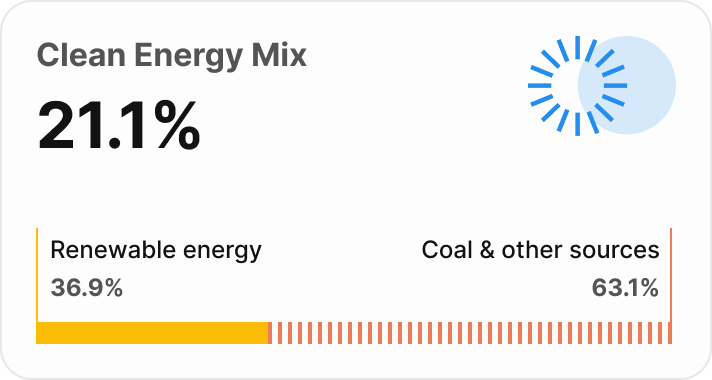
The Clean Energy Score — your facility’s percentage of hourly load matched with renewable or low-carbon energy — is becoming the next big KPI.
**Here are two actionable pathways:**
**🔹 Green Day-Ahead Market (GDAM) + Flexible Bidding**\
Procuring renewable energy blocks during solar-heavy hours through GDAM, and dynamically adjusting shift loads, can push your score above 60%.
**🔹 Behind-the-Meter BESS (Battery Energy Storage Systems)**\
Deploying 2–4 hours of on-site storage allows you to absorb cheap solar power and discharge during evening peaks — a fast-track to 80%+ CFE coverage.
> **💡 Quick Tip:** New Viability Gap Funding (VGF) schemes for battery projects can shave off 20–30% of your initial storage investment.
### How Grid Insight Can Help
Grid decarbonization is a rising tide in India, but only those who ride the hourly wave — not just annual averages — will lead the next era of sustainable growth. In 2025, industries, businesses and institutions are under more pressure than ever to prove their renewable energy impact - not just claim it.
At Grid Insight, we’re decoding your Clean Energy Score - by tracking the exact energy mix from your utility, your location, and your actions. Because every energy decision counts.